
Numismatics How to understand Krause-Mishler (KM) numbering
Numismatics Instructions for use
Krause-Mishler numbering, or KM numbering, takes its name from the authors of the reference works "World Coin Catalog of World Coins". These are 5 numismatic quotation catalogs listing the world's coins from 1600 to the present day. Authors Krause and Mishler use this numbering to uniquely identify the coins referenced in these catalogs. Used by amateur and professional collectors alike, the catalogs present coins and quotations in various states of preservation, in English, with quotations in US dollars.
Standard Catalogue of World Coinsa worldwide reference for numismatic quotation
Each catalog corresponds to a century of coin production, featuring tens of thousands of coins. Numerous numismatic experts from all over the world work on enriching these works every year. There are currently 5 different catalogs:
- Standard Catalog of World Coins 1601-1700
- Standard Catalog of World Coins 1701-1800
- Standard Catalog of World Coins, 1801-1900
- Standard Catalog of World Coins, 1901-2000
- Standard Catalog of World Coins, 2001-Date
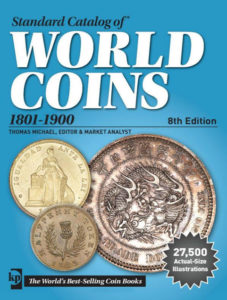
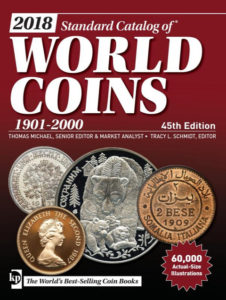
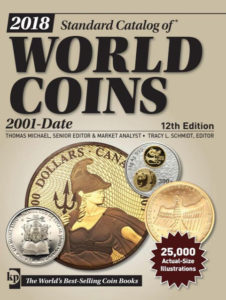
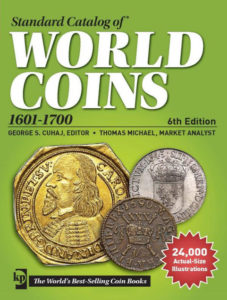
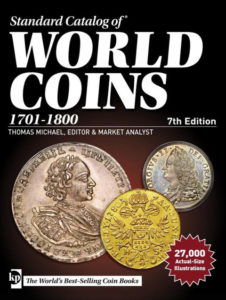
One of the special features of these catalogs is that they are written in English. The introduction provides useful information on coin identification, with an index for each country and correspondence tables on the state of preservation and dates of the coins.
Coins are listed by country, which in turn are listed alphabetically. The Standard Catalog of World Coins locates the country with a map, and indicates the geopolitical situation and monetary system according to the century of the book. The "Instant Identifier" identifies countries according to their coats of arms or symbols.
For each country, coins are listed by denomination, from smallest to largest. A great advantage of these catalogs is that the coins are shown in their exact size. For each type of coin, there are various indications: date, weight, diameter, metal, quantities produced and the US dollar rating of the coins in 5 different states of preservation (F, VF, XF, Unc, BU).
Numismatics User Guide: Understanding KM numbering

For each country, the numbering starts at KM#1 and increases in chronological order. When there are several variants of the same coin, the number is indicated after a period. For Egypt, for example, there is a KM#553.1 and a KM#553.2.
If the coin is struck in a different metal, this is indicated by a letter after the number. For example, in Finland, KM#45 is struck in copper and KM#45a in aluminum.
Catalogs also feature different initials in different languages to indicate that the coin is a trial: "E" in French, "Pn" in English (=pattern), "P" in German (=probe), depending on the country of sale. Other initials such as "P" indicate a Piéfort, i.e. a coin produced in limited numbers, or "Tn" for a token. The addition of an "A" means that the coin has been minted again.
The Standard Catalog of World Coins also sometimes uses existing numbering from R.S. Yeoman's "Modern World Coins", noted Y#; or William D. Craig's "Coins of the world", noted C#.
The 5 Standard Catalogs of World Coins are benchmarks in the world of numismatics. They give professionals and amateur collectors alike an idea of the estimated value of the world's coins. However, the catalogs are also criticized for their inaccuracies for certain coins, and for reprinting catalogs for purely commercial purposes. Find out more with the Coin World podcast.
To be sure of the value of coins for sale or purchase, go to a specialized Comptoir that will give you all the advice you need. Like CaraOr, with offices in Rixensart south of Brussels and in Liège, will value your coins free of charge and at the right price.