

Argenterie et Bijouterie, comment reconnaître les Poinçons les plus courants?
Often illegible to the naked eye, tiny little marks are carved into our rings, necklaces, watches, cutlery, ingots and coins. These are hallmarks, an official seal affixed to precious metal objects in gold, silver and platinum. They often consist of the manufacturer's initials, a symbol or both, and have a precise, regulated meaning. The aim of this article is to demystify hallmarks and their meaning.
meanings.
Why are hallmarks used?
A punch is a small metal instrument used to place a mark on an object.
In jewelry and silverware, the hallmark is an official mark attesting to the gold, silver or platinum content of an object. It can also be used to determine the object's origin. Issued by the manufacturer or the State, the hallmark is a guarantee for precious metals to avoid the risk of counterfeiting.
The hallmark is applied to a variety of objects, including necklaces, rings, bracelets, earrings, watches, silverware and gold and silver ingots and coins. The hallmark is often found on the least visible side of the object, so as not to detract from its beauty.
Different hallmarks for different metals and states
Different countries have different systems for hallmarking objects. In Belgium, France and Switzerland, each item is identified by a unique hallmark.
In Belgium: Signature and Title Marks
According to the Treasury - Federal Public Service of Finance in Belgium, the books sold bear two hallmarks:
- the manufacturer's mark, called the Signature Mark, informs the consumer of the nature of the precious metal and its titre;
- and the Title hallmark, which indicates the title in thousandths with the metal symbol, identifying the agent or manufacturer.
The Signature Mark consists of a symbol that has been approved by the Mint Commissioner. This symbol will always be delimited by a barrel shape. Initials may also accompany the chosen symbol.
The Title Mark will have a particular geometric shape for each metal, a diamond for gold, an oval for silver and a rectangle with cut corners for platinum. The letters au (gold), AG (silver) and PT (platinum) indicate the metal used and precede the title in Arabic numerals.
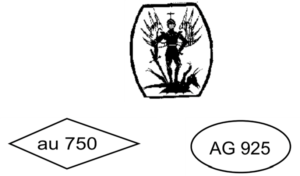
PHOTO - Caption: Royal Mint guarantee stamps
In France: Poinçons de Responsabilité and
of Title
In France, every work of gold, silver or platinum must be marked with 2 hallmarks:
-the Responsibility Mark (master, manufacturer or importer). This identifies the workshop from which the piece was made. It takes the form of a diamond, completed with the initials of the craftsman who created the piece. If the hallmark is oval, the object has been imported.
-the title or guarantee hallmark (title of the work affixed by customs). Square-shaped hallmarks mean that the object is not made of pure precious metal, gold or silver, but of plated metal.
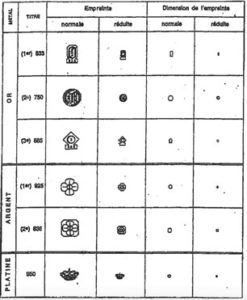
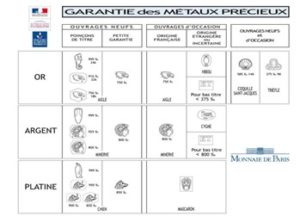
PHOTO - Caption: Monnaie de Paris guarantee hallmarks for precious metals
In Switzerland: Master and Inspection Marks
In Switzerland, all precious metal objects must be stamped with the:
- Master hallmark, to identify the exact composition and marking of the work.
- Poinçon de Contrôle represented since 1995 by a Saint-bernard's head made in France.
Central Office for Precious Metals Control, Berne.

Legend: On the left, examples of Title Marks and on the right the Swiss Control Mark for all precious metals and legal titles.
Are all gold, silver and platinum objects hallmarked?
In theory, yes. In practice, for natural reasons, such as the contact of jewelry with the skin, which increases the chances of the hallmark fading, or for regulatory reasons, many objects may not be hallmarked.
In Belgium, for example, precious metals are only hallmarked if there is no risk of damage. Works of art and antiques are not subject to hallmarking. What's more, hallmarks are affixed by the professionals themselves, resulting in a large number of different hallmarks. The Royal Mint only affixes the State hallmark to gold, silver and platinum medals, as well as ingots.
In France, jewels weighing less than 3 grams, those made before 1838 and those that cannot bear the hallmarks without deterioration are exempt from warranty hallmarks.
In Switzerland, before the single Poinçon de Contrôle in 1995, there were around ten different hallmarks. In addition, multi-metal and plated products must also bear a master hallmark.
That's why it's so important to have your gold, silver and platinum items appraised. Whether in good condition or defective, the surest way to find out whether your objects are gold, silver or platinum is to have them by a professional. You can easily have your goods appraised in the province of Brabant Wallon in Rixensart at the following agency Caraor, with or without an appointment.